Money Doesn’t Buy Happiness, But It Buys Space to Think
A reflective look at how financial stability creates the mental space to question fulfillment, redefine success, and pay attention to what actually matters.
PERSONAL
1/21/20263 min read
I’ve been thinking a lot lately about how we even arrive at questions like What does fulfillment mean? or How do I define success for myself?
Not the answers, just the ability to think and ask those questions in the first place.
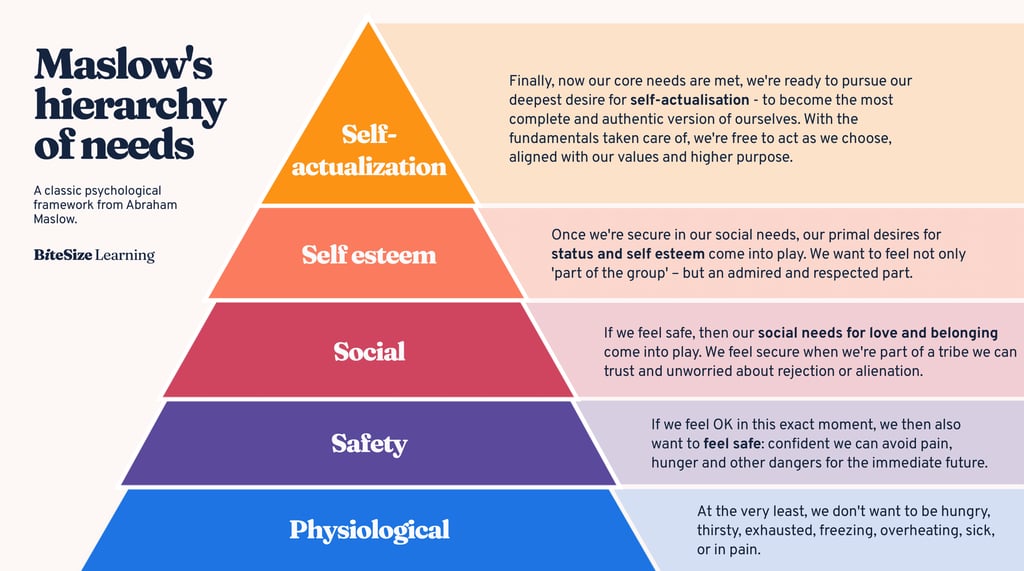
Maslow’s Hierarchy of Needs often comes to mind when people talk about self-actualization, but I didn’t think to fully appreciate it until recently. This idea that self-actualization sits at the top isn’t because it’s more important than everything else, rather it is because it requires everything below to be met and remain relatively quiet.
As you can imagine, it’s hard to think about meaning when you’re thinking about food and shelter. The necessities to survival.
When your energy is spent worrying about how to cover rent, or when the next time food will be on the table, or healthcare bills, or the next unexpected bill, there isn’t much room left to sit and reflect on purpose or fulfillment. Your brain is doing exactly what it needs to do, keeping you afloat. So, in that sense, Maslow’s pyramid isn’t aspirational. It’s conditional.
And that’s where money, uncomfortable as it is to talk about, plays a vital role.
Not as happiness. Not as success. But as a tool to create space.
We see constant headlines about the rising cost of living, how everyday comforts and long-term goals like homeownership are starting to feel increasingly out of reach. I’m not saying that money doesn’t create meaning, but it can definitely reduce the noise. It can buy time, stability, predictability, and when you have no stress on your cost of living situation it can finally create room for your thoughts. Room to ask those bigger questions without everything feeling urgent. Maybe that’s why so many ultra-wealthy people start sounding more spiritual or philosophical once they’ve reached a certain level of success, as if they’re trying to pass along what they’ve learned about life and purpose.
I’m increasingly aware that even having the time and mental capacity to think about fulfillment is a privilege. That awareness doesn’t come with pride, and it doesn’t come without discomfort. It’s more of a quiet recognition of my current circumstances that allow me to reflect instead of react.
That wasn’t always the case.
There were periods in my life, like when I was a student, where success meant something very simple, making enough to cover everyday expenses, avoiding mistakes I couldn’t afford, and keeping things from falling apart. During those times, fulfillment wasn’t even a question. Stability was.
And honestly, that makes sense. Money is often framed as shallow or corrupting, yet a certain amount of it is needed and simply practical. It may not solve everything, especially the parts of life that sit higher on the hierarchy like relationships or personal accomplishments, but it does shift the problems you’re able to focus on. It shifts your focus from How do I get through this? to What do I want to build? or What actually matters to me?
There’s a difference between wanting more money and wanting enough money. Enough to not constantly stress. Enough to say no sometimes. Enough to slow down and notice when something feels off. Enough to ask whether the path you’re on is actually yours.
It’s subtle, but significant.
And once survival stops being the primary driver, success starts to feel less obvious. Titles, income, and milestones don’t suddenly disappear, but they definitely begin to lose some of their authority. You start noticing when you’re doing things out of habit instead of intention. You realize that hitting certain goals doesn’t automatically bring clarity.
In some ways, it can be unsettling. The structure that once guided us no longer feels aligned to ourselves. But I think it just means that we’re reaching a pivotal moment in our life.
And I think that’s part of my reason why I started this blog.
Not because I’ve figured anything or everything out, but because I finally believe that I now have the space to think without everything screaming for my attention. Writing is not wasting my space, but has created this feeling of freedom and expression. Allowing to take these thoughts seriously enough to sit with them, even if they’re unfinished.
Self-actualization, if that’s even the right word, doesn’t feel like something you just arrive at. It feels more like paying attention. It’s something you drift in and out of as life changes, and is fragile. A space that can disappear at any point, but suddenly reappear.
That’s probably why I’m feeling grateful for it right now. Not in a performative way, nor with the guilt; just aware. Aware that this season of my life allows me to slow down and reflect, and aware that it won’t always look like this (as I’m certain, life has its surprises).
If nothing else, this blog is my way of honoring that awareness. Of thinking honestly while I can, asking questions without rushing to answers, and trying to define success in a way that actually fits how I want to live and not just how it looks on paper.